
The Ultimate 5-Day Photographic Tanzania Safari: An Extraordinary Wildlife Photography Adventure (2027–2029)
By the time you step onto the tarmac in Kilimanjaro in 2027, 2028, or 2029, the camera landscape will have fully settled into the mirrorless era, and the dust will have settled on the sensor wars. The cameras you bring need to be fast, they need to handle high ISOs cleanly, and they need to be sealed against the finest dust on the planet.
For the primary body, you want a high-resolution flagship mirrorless camera. We are talking 45 to 60 megapixels. Why? Because in the Serengeti, you will often find yourself wishing you had more reach. A high-resolution sensor allows you to crop heavily in post-production without losing the ability to print large. Furthermore, by this time, global shutter technology will be standard on top-tier bodies. This is a game-changer for wildlife. It eliminates rolling shutter distortion when panning with a running cheetah and allows you to shoot with flash at any shutter speed, though you won’t be using flash here.
Your lens selection is the most critical decision you will make. Leave the heavy zooms at home if they aren’t fast. You need three focal lengths. First, a 400mm f/2.8. This is your workhorse. It is heavy, yes, but the light-gathering capability allows you to keep your ISO down when the sun drops behind the crater rim, and the shallow depth of field melts the messy, twiggy backgrounds of the bush into a smooth bokeh. Second, a 600mm f/4 or a high-end 1.4x teleconverter for your 400mm. You will want this reach for small birds, distant lions, or when you are restricted by the rules of the national park and cannot get closer. Third, a 24-70mm f/2.8 or a 70-200mm f/2.8. Do not skip this. The biggest mistake first-timers make is only shooting tight. You need wide angles to capture the landscape, the massive baobabs of Tarangire, and the environmental context of the animals. A lion is just a cat; a lion sitting on a kopje under a vast, stormy Serengeti sky is a story.
But the camera is only half the battle. The vehicle is the other half. You will be shooting from a modified Toyota Land Cruiser. These vehicles have pop-up roofs, which is excellent, but the roof itself can vibrate. Do not rely on handheld shooting for your long lenses. You need a proper vehicle rig. Bring a heavy-duty bean bag. Do not use the cheap ones filled with synthetic beans that shift and lose shape. Bring a high-quality, ruggedized bag and fill it with dried beans or even the local maize you buy at the market before the trip. Rest the camera and lens barrel directly on the bag. This provides a rock-solid platform that absorbs the idle vibration of the diesel engine.
Alternatively, if you prefer a mechanical mount, a clamp-on gimbal head that attaches to the roof struts is brilliant, but ensure your guide is comfortable with it. Some guides find them cumbersome when they need to close the roof quickly during a sudden downpour.
Dust management is not a suggestion; it is a religion. The red dirt will find its way into every seam of your bag. Bring a small, soft-bristled brush and a rocket blower. Clean your lens filters daily. More importantly, change lenses inside the vehicle, with the windows rolled up, and keep the camera pointed downward when you do swap them so gravity works in your favor. Bring a sensor loupe and a swab kit. You will need to clean your sensor at least once during a five-day trip.
The Human Element: Guides, Trackers, and the Maasai
You can have a hundred thousand dollars worth of glass strapped to your chest, but if your driver does not know where the animals are, you will shoot nothing but grass. In Tanzania, your guide is your tracker, your naturalist, your mechanic, and your lighting assistant.
When you book this 2027–2029 trip, specifically request a guide who understands photography. There is a distinct difference between a standard safari guide and a photographic guide. A standard guide wants to show you the Big Five, get the sightings, and move on to the next animal. A photographic guide understands light. They know that at 4:00 PM, the sun will be at a specific angle that will backlight the dust kicked up by a herd of elephants, creating a halo effect. They know how to position the vehicle so that the animal is not in the shadow of a tree, and they know how to turn off the vehicle engine to eliminate vibration when you are shooting at 1/50th of a second.
Communicate your needs early. Tell your guide on day one that you need time to set up your shots. Tell them you want to stay with a subject for an hour if the light is good, rather than driving past it after five minutes. A good guide will respect this. They will also act as your spotter. The human eye is terrible at scanning the tall, dry grass of the Serengeti. Your guide’s eyes are trained to pick out the horizontal line of a resting lioness or the slight movement of a leopard’s tail in a tree.
You will also encounter the Maasai people. They are the traditional custodians of much of this land. If you are shooting outside the strict boundaries of the national parks, or if you visit a manyatta (village) arranged by your camp, approach with respect. Put the long lens away. Use a 35mm or 50mm prime. Ask for permission. The best portraits are not taken by shoving a camera in someone’s face; they are taken after you have shared a joke, accepted a cup of sweet, milky tea, and established a human connection. The light in their eyes will be different, and your photographs will reflect that trust.
Day 1: Tarangire – Giants in the Shadows of Baobabs
Your flight lands in Arusha or directly at the Kuro Airstrip. The heat hits you the moment you step out of the Cessna. You are met by your guide, the vehicle is loaded, and you drive straight into Tarangire National Park.
Tarangire is often overshadowed by the Serengeti, which is a mistake. In the dry season (which we are assuming for this itinerary, typically June through October), Tarangire is a masterpiece of texture and scale. The Tarangire River is the only source of water for miles. This draws in massive herds of elephants. We are talking about hundreds of elephants, converging on the riverbanks.
Your first afternoon is about acclimatization and shooting the giants. The light in Tarangire is filtered through the massive, sprawling branches of the Adansonia digitata, the baobab trees. These trees look like they were planted upside down, their roots reaching into the sky. They are gnarled, ancient, and deeply photogenic.
Do not just shoot the elephants drinking. That is the cliché shot. Look for the interactions. Look for the matriarch. Watch how the younger elephants interact with the calves. Look for the dust. When an elephant throws dust over its back to protect its skin from the sun, it creates a spectacular cloud. If you position your vehicle downwind, and the sun is behind you, you can capture that dust cloud illuminated by the late afternoon sun. Use a fast shutter speed, at least 1/1000th of a second, to freeze the individual particles of dust in the air.
Tarangire is also home to the fringe-eared oryx and the gerenuk, the long-necked antelope that stands on its hind legs to browse. These animals have striking, angular profiles. They look almost alien against the backdrop of the dry, yellow grass. Use your 400mm lens to isolate them. Drop your exposure compensation by about a third of a stop. The dry grass will try to trick your camera’s meter into overexposing the image. By underexposing slightly, you retain the rich, warm tones of the dry season and prevent the highlights on the animals’ coats from blowing out.
As the sun dips below the horizon, the sky over Tarangire often catches fire. The silhouettes of the baobabs against a purple and orange sky are a mandatory shot. Switch to your wide-angle lens. Stop down to f/8 or f/11 to get the stars just starting to appear in the deep blue of the twilight. Focus manually on the brightest star or the horizon line. This is your first sunset. Take a breath. Drink the warm gin and tonic your guide has poured from the back of the Cruiser. You are in the bush now.
Day 2: Ngorongoro – The Microcosm of the Caldera
You wake up before dawn. The air is crisp. Tarangire is at a higher altitude, but the Ngorongoro Conservation Area is even higher. You drive to the rim of the crater. The view from the top is staggering. It is a collapsed volcanic caldera, formed millions of years ago. It is roughly 100 square miles of floor, surrounded by sheer walls that are 2,000 feet high. It is a closed ecosystem. The animals born here usually die here.
The descent is steep and bouncy. Keep your camera in your lap, not on the roof rig, as the vehicle bounces heavily on the way down. Once on the floor, the environment changes completely. It is greener, marshier, and the density of life is staggering.
Ngorongoro is famous for having one of the densest populations of lions in the world, and it is one of the best places to see the endangered black rhinoceros. But from a photography standpoint, Ngorongoro presents a massive challenge: light.
Because the crater walls are so high, the floor is in deep shadow for the first two hours of the morning, and the shadows return early in the afternoon. If you try to shoot a black rhino at 8:00 AM, it will be in flat, shadowless, or heavily contrasted light.
How do you handle this? You adapt. When the light is flat and harsh, stop trying to shoot golden, backlit portraits. Switch your mindset to graphic photography. Look for high contrast. Look for the stark black of a rhino against the pale green of the swamp grass. Push your exposure to make the blacks truly black and the highlights bright. Shoot in black and white in your mind, even if you are capturing in RAW color. The texture of a rhino’s skin, which looks like overlapping plates of medieval armor, pops beautifully in high-contrast, monochromatic-style lighting.
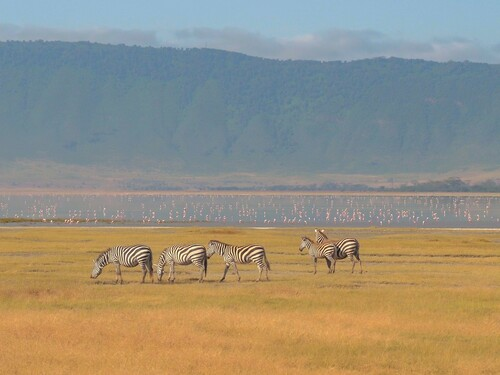
Lake Magadi, the soda lake in the center of the crater, is often painted pink by tens of thousands of flamingos. This is a great subject for your 600mm lens. The challenge here is the heat haze. By mid-morning, the sun bakes the crater floor, and the air above the shallow, alkaline water shimmers. This heat haze will destroy your sharpness at long focal lengths. If you want tack-sharp images of the flamingos, you need to shoot them early, before the sun gets high, or wait for the late afternoon when the air cools.
Around midday, when the light is terrible and the animals are resting in the shade, this is the time to drive to the hippo pools. The hippos will be submerged, with only their eyes and ears above the water. This is a great time to experiment with water-level perspectives. If your guide can safely position the vehicle near the edge of the pool, rest your lens right on the bean bag, as low as possible. Include the water ripples in the foreground. The reflections of the sky and the surrounding acacia trees in the water will frame the hippos beautifully.
Ngorongoro is also home to the Maasai herdsmen who bring their cattle down to the floor to water. Seeing a traditional Maasai herder, wrapped in his red shuka, walking alongside a massive bull elephant is a surreal juxtaposition of cultures and species. It speaks to the complex, shared history of this landscape. Capture these moments. They are fleeting and deeply human.
Day 3: The Serengeti Transition – Endless Plains and Granite Kopjes
Day three is the transition into the Serengeti. The drive from Ngorongoro to the Serengeti National Park takes several hours, but do not put your camera away. The landscape changes gradually from the highland grasses to the vast, rolling plains of the Serengeti. The name Serengeti comes from the Maasai word “siringet,” which means “the place where the land runs on forever.” You will understand why the moment you crest the first hill and see the horizon stretching out in a flat, unbroken line.
We are heading into the Central Serengeti, the Seronera area. This is the classic Serengeti of documentaries. It is a landscape of extremes. The grass can be waist-high and golden, or short and green, depending on the localized rainfall.
The defining geological features of the Seronera region are the kopjes. These are massive outcrops of granite rock that rise abruptly from the plains. They are billions of years old, smoothed by wind and water. More importantly, they are the real estate of the leopard.
Leopards love kopjes. They provide shade in the form of deep, cool caves, and they offer a vantage point to survey the plains for prey. Finding a leopard in a kopje is a triumph. But photographing it is a puzzle. The rocks create deep, messy shadows. The leopard will often be tucked into a crevice, half in the sun, half in the dark.
When you find a leopard in a tree or on a rock, patience is your only tool. Do not just take ten shots and leave. Stay for an hour. Watch the light. Wait for the leopard to move from the shadow into a patch of sunlight. When it does, the dappled light filtering through the acacia leaves will create a stunning pattern on its rosettes. Use spot metering on the leopard’s face to ensure the eyes are perfectly exposed, letting the background fall into darkness.
The kopjes are also the domain of the cheetah. Unlike leopards, cheetahs avoid the dense brush and the rocky caves. They prefer to sit on top of termite mounds or low branches in the open plains to scan for prey. This makes them much easier to see, but harder to photograph well because there is nowhere to hide the vehicle.
When you find a cheetah on a termite mound, you have a classic portrait opportunity. The cheetah’s posture is usually upright, alert, and tense. The tear marks running from its eyes to its mouth are a distinctive feature. Get tight on the face. But also, pull back. Use your 70-200mm lens to include the vast expanse of the grass around it. A cheetah is built for speed, and showing the empty space around it emphasizes the lonely, exposed nature of its existence. It is a fast animal living in a world where it can easily be stolen from by larger predators. The negative space in your composition tells that story.
As the afternoon progresses, the light in the Serengeti takes on a unique quality. The air is filled with microscopic dust and dry grass particles. When the sun gets low, this particulate matter catches the light, creating a soft, diffused glow. The harsh shadows of midday disappear. The entire landscape seems to emit a warm, amber light. This is the time to shoot the plains animals: the Thomson’s gazelles, the wildebeest, the zebras. The stripes of the zebra, often a nightmare to shoot in harsh light because of the contrast, become soft and beautiful in this late afternoon glow.
Day 4: Serengeti – The Predator-Prey Dynamics and the Ethics of the Lens
Your final full day is dedicated to the deep Serengeti, pushing further out from the central Seronera area, or focusing intensely on the predator-prey dynamics that define this ecosystem. This is the day you chase the drama.
The lion prides of the Serengeti are legendary. They are large, cohesive, and accustomed to vehicles. You can often get incredibly close to them. But proximity does not automatically equal a good photograph. A lion sleeping in the grass is nice, but a lion interacting with its environment, or with its pride, is a story.
Look for the sub-adult males. They are the teenagers of the lion world. They are clumsy, playful, and constantly getting into trouble with the adult males. Watching two young brothers wrestle, bite each other’s ears, and tumble through the grass provides endless photographic opportunities. Use a fast shutter speed, 1/2000th of a second or higher, to freeze the motion of their paws and the flying dust. Track them with your continuous autofocus (AF-C or AI Servo). Ensure your camera is set to track the eye, as modern 2027 mirrorless bodies will lock onto the lion’s eye and refuse to let go, even if another lion crosses in front of the frame.
But day four is also about the hunt, and this brings us to the ethics of wildlife photography.
You are driving in a vehicle, and suddenly, the guide kills the engine. The lions are frozen, staring intently at a herd of wildebeest. The tension in the air is palpable. The hunt is on.
As a photographer, your instinct is to shoot. You want to capture the explosion of speed, the dust, the raw power of the predator. But you must also be a student of nature. Understand that for the lion, this is not a photo opportunity; it is a matter of life and death. If they fail, their cubs starve.
Do not use flash. Do not drive off-road to cut off the prey. Do not make noise to spook the animals into running. Your job is to be a ghost. Position the vehicle where the light is best, set your camera to a high frame rate (15 to 20 frames per second), and let the event unfold.
If the hunt is successful, and the lion brings down a gazelle or a wildebeest, the scene will turn gruesome. This is the reality of the wild. Do not look away, but also, do not feel compelled to document every single moment of the feeding. Take your shots of the kill, capture the power and the reality of the food chain, and then, put the camera down. Watch with your own eyes. Experience the visceral reality of the bush without a piece of glass between you and the animal. The best photographers know when to stop shooting.
If the hunt fails, the prey escapes. The lions will pant, lick their wounds, and walk away. The dust will settle. This is the time to photograph the aftermath. The heavy breathing of the lion, the dust clinging to its sweaty coat, the look of frustration in its eyes. These quiet moments of failure are often more poignant than the chaotic moments of success.
In the late afternoon, you might encounter a leopard dragging a kill up into a tree. This is one of the most difficult feats of strength in the animal kingdom. A leopard can carry prey twice its own weight up a vertical trunk. If you witness this, you need to be ready. The light will likely be fading. You will need to push your ISO to 6400 or 12800. Do not be afraid of noise. A sharp, noisy image of a leopard struggling up a tree with an impala in its jaws is infinitely better than a clean, blurry one. Modern noise reduction software in post-processing will handle the grain, but it cannot fix a missed focus.
Day 5: The Final Light – Blue Hour and the Journey Home
Your final morning starts before the sun even thinks about rising. You are out on the plains for the blue hour. This is the twenty minutes before sunrise when the sky is a deep, saturated cobalt. The animals are waking up. The lions are roaring in the distance, a sound that vibrates in your chest. The hyenas are whooping, their manic laughter echoing across the grass.
The light during blue hour is incredibly soft and even. There are no shadows. It is perfect for wide landscape shots. Set your camera on a tripod if you have one, or rest it securely on the bean bag. Use a low ISO, 100 or 200, and stop down to f/11. You want the entire landscape, from the foreground grass to the distant horizon, to be tack sharp.
Look for the silhouettes of the acacia trees against the lightening sky. As the sun gets closer to the horizon, the sky will transition from blue to purple, to pink, to a blazing orange. This is the “magic hour.” The light is raking across the plains at a low angle, highlighting every single blade of grass, every ripple in the dirt.
This is your last chance to get the classic Serengeti sunrise shot. Find a lone tree, or a group of giraffes walking along the horizon, and frame them against the rising sun. Use a lens flare intentionally if you want a dreamy look, or use a lens hood to keep the glass clean and the contrast high.
When the sun finally breaches the horizon, the temperature rises rapidly. The thermal currents start, and the dust begins to kick up again. The window of perfect light closes. You pack up the gear. The guide starts the engine, and the long, bumpy drive back to the airstrip begins.
The flight back to Arusha or Kilimanjaro is usually in a small Cessna Caravan. You will be sitting near the window. Keep your camera handy. The aerial views of the Serengeti, the Great Rift Valley, and the distant, snow-capped peak of Mount Kilimanjaro are breathtaking. The patterns of the herds from the air look like spilled ink on a golden canvas.
As you land, the transition back to civilization is jarring. The smell of the bush is replaced by the smell of jet fuel and coffee. The silence of the plains is replaced by the noise of the airport. You will feel exhausted. Your back will ache from the bumpy roads, your eyes will be tired from staring through the viewfinder, and you will be covered in a fine layer of red dust that no amount of brushing seems to remove.
The Ultimate 5-Day Photographic Epilogue: The Darkroom of the Mind
The safari is over, but the work is only half done. When you return home and import those thousands of RAW files into your computer, you will face the daunting task of culling. You will have hundreds of images of the same lion, the same elephant, the same landscape.
Be ruthless. Delete the blurry ones. Delete the ones where the animal is blinking. Delete the ones where a branch is growing out of the animal’s head.
When you start editing, remember the light you experienced. Do not over-process. The temptation with modern software is to push the saturation, crush the blacks, and create an image that looks hyper-real. Resist this. The African bush has its own inherent color palette. The greens of the grass, the yellows of the dry season, the reds of the soil, and the deep blues of the sky. Enhance them, but do not distort them.
Use the clarity and texture sliders sparingly to bring out the details in the animal’s fur or the rough skin of the elephant, but keep it natural. The goal of your post-processing should be to transport the viewer back to that exact moment in the Land Cruiser. They should feel the heat, smell the dust, and sense the tension of the wild.
Looking back at the 2027–2029 window, you will realize that you were there at a unique time. The world is changing. The climate is shifting the ancient migration routes. The technology in your camera bag is more advanced than anything the explorers of the twentieth century could have dreamed of. Yet, when you sit in the bush, waiting for a leopard to emerge from the shadows of a granite kopje, none of that matters. The technology fades away. The dust settles. There is only you, the light, and the ancient, unbroken rhythm of the Serengeti.
That is what you are really photographing. You are not just capturing animals; you are capturing time. You are freezing a fraction of a second in an ecosystem that has been running on the same clock for millions of years.
Pack your gear. Check your sensor. Bring extra batteries. The red dust is waiting.
For more information contact https://summerwinteradventures.com/
