
Climbing Kilimanjaro via 6 Day Machame Route is one of the most popular ways to reach the summit of Mount Kilimanjaro. Known as the “Whiskey Route,” Machame is famous for its beautiful scenery, changing landscapes, and excellent views of the mountain.
This itinerary gives you six days on the mountain, allowing you to climb at a steady pace while taking time to adjust to the increasing altitude. The extra time compared with shorter Kilimanjaro programs gives your body a better opportunity to acclimatize before summit night.
The Machame Route approaches Kilimanjaro from the southern side and passes through several distinct ecological zones, from lush rainforest to moorland, alpine desert, and finally the Arctic-like environment around the summit.
You will camp in mountain tents throughout the climb and be accompanied by an experienced mountain guide, porters, and a cook. After reaching Uhuru Peak at 5,895 metres, you will descend through the mountain forest before returning to your hotel.
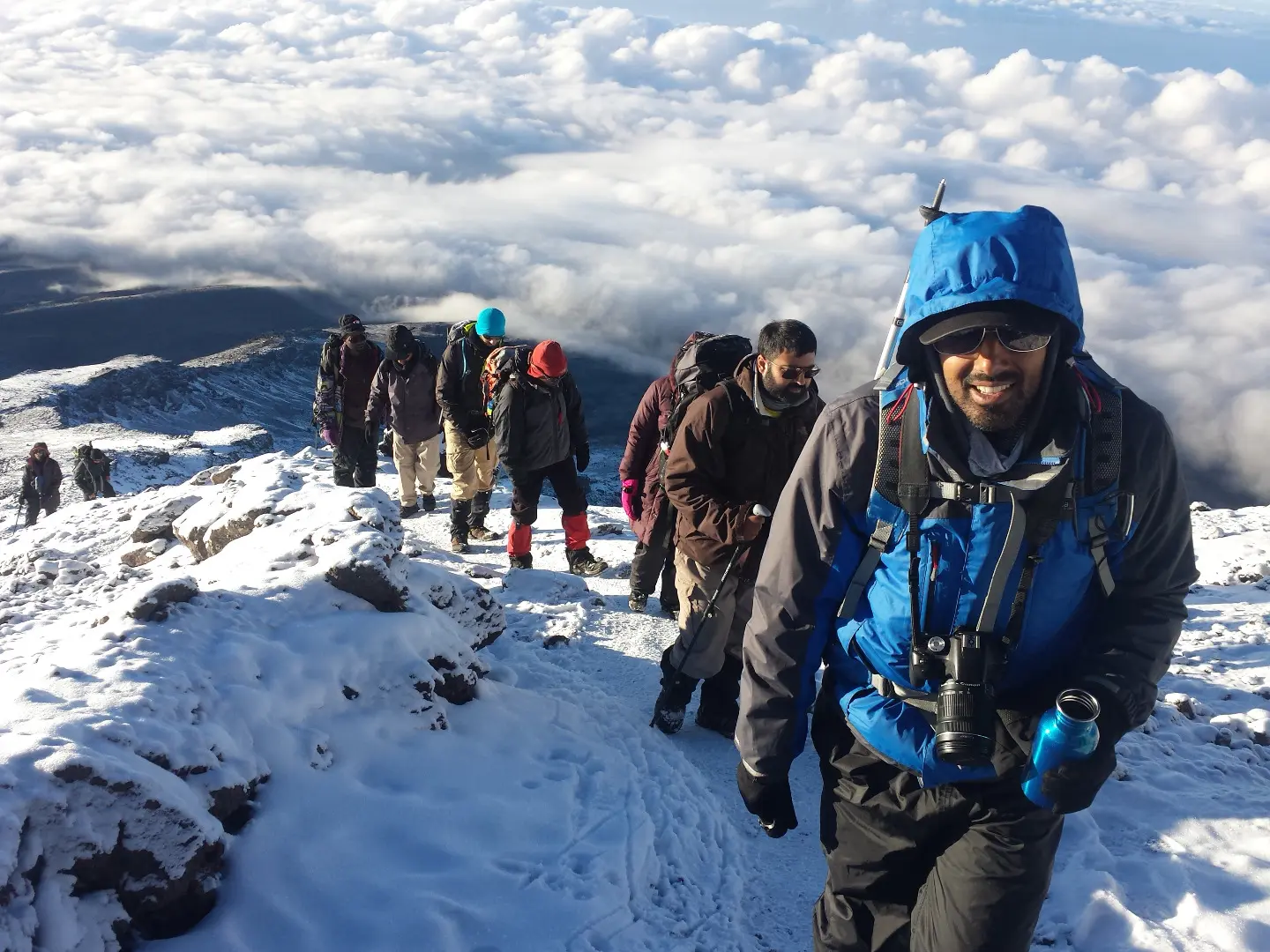
Climbing Kilimanjaro via 6 Day Machame Route Tour Highlights
- Climb Mount Kilimanjaro through the scenic Machame Route
- Reach Uhuru Peak, 5,895 metres, the highest point in Africa
- Spend six days trekking on the mountain
- Enjoy spectacular views of Kilimanjaro and the surrounding landscape
- Walk through rainforest, heathland, moorland, alpine desert and high-altitude terrain
- Experience the famous Barranco Wall
- Enjoy a gradual acclimatization schedule
- Camp in designated mountain camps
- Professional and experienced mountain guides
- Support from a mountain crew, including porters and cook
- Enjoy a full summit attempt with sunrise views from the roof of Africa
Detailed 8-Day Itinerary
Day 1: Arrival in Tanzania – Transfer to Moshi
Distance: Depending on your arrival airport
Accommodation: Hotel in Moshi
Meal Plan: Bed and Breakfast
You will be met at the airport by our representative and transferred to your hotel in Moshi, the main starting point for most Kilimanjaro climbs.
After checking in, you will have time to relax and recover from your journey. Your guide will meet you at the hotel for a detailed briefing about the climb.
During the briefing, the guide will go through the trekking program, mountain safety, what to expect each day, and the equipment you will need. Your climbing equipment can also be checked to make sure you have everything required for the mountain.
If anything important is missing, your guide can advise you on equipment available for hire.
Take the evening to rest and prepare for the climb ahead.
Overnight: Hotel in Moshi
Day 2: Machame Gate to Machame Camp
Elevation: 1,800 m – 3,000 m
Distance: Approximately 11 km
Hiking Time: 5–7 hours
Habitat: Rainforest
Meal Plan: Breakfast, Lunch & Dinner
After breakfast, you will leave Moshi and drive to Machame Gate, the starting point of the Machame Route.
The journey takes you through local villages and agricultural areas before reaching the mountain gate. At the gate, your guide will complete the registration and park entry procedures while the porters organize the equipment.
Once everything is ready, your trek begins.
The first section of the trail passes through thick tropical rainforest. The forest is usually cool and shaded, with tall trees, ferns and plenty of vegetation. You may also hear birds and, occasionally, spot some of the wildlife that lives on the lower slopes of Kilimanjaro.
The trail gradually becomes steeper as you make your way towards Machame Camp.
This first day is not a race. Walking slowly from the beginning helps your body start adjusting to the altitude.
You will arrive at Machame Camp in the afternoon, where the mountain crew will have prepared your tents. After settling in, you can relax and enjoy dinner before getting some rest.
Overnight: Machame Camp
Day 3: Machame Camp to Shira Camp
Elevation: 3,000 m – 3,845 m
Distance: Approximately 9 km
Hiking Time: 4–6 hours
Habitat: Moorland
Meal Plan: Breakfast, Lunch & Dinner
After breakfast, you leave the rainforest behind and continue climbing towards the Shira Plateau.
The vegetation becomes shorter as you gain altitude, and the landscape changes from dense forest to open moorland. You will see giant heather plants, grasses, volcanic rocks and wide views across the mountain.
The trail becomes steeper in places as you climb along the ridge towards the Shira Plateau.
One of the highlights of the day is the changing view of Kibo, the main volcanic cone of Kilimanjaro. As the clouds clear, you may get your first impressive views of the summit.
You will eventually reach Shira Camp, located on the western side of the Shira Plateau.
The afternoon is normally spent resting, eating and allowing your body to adjust to the higher altitude.
If the weather is clear, the sunset and evening views from Shira can be spectacular.
Overnight: Shira Camp
Day 4: Shira Camp to Barranco Camp via Lava Tower
Elevation: 3,845 m – 4,630 m – 3,960 m
Distance: Approximately 10 km
Hiking Time: 6–7 hours
Habitat: Semi-desert / Alpine Desert
Meal Plan: Breakfast, Lunch & Dinner
Today is an important acclimatization day.
You will leave Shira Camp and continue eastwards across the high-altitude landscape. The vegetation becomes increasingly sparse as you enter the alpine desert zone.
The trail takes you towards Lava Tower, which stands at approximately 4,630 metres. This is a significant point on the route because you climb to a higher elevation during the day before descending to a lower sleeping altitude.
This is commonly referred to as “climb high, sleep low,” an important part of acclimatization.
After spending some time around Lava Tower, you begin the descent towards Barranco Camp.
The descent gives your body an opportunity to adjust to the altitude before you spend the night at a lower elevation.
The landscape around Barranco is dramatic, with the enormous Barranco Wall rising above the camp. On clear days, you can also enjoy impressive views of Kibo.
Dinner will be served at camp before you settle in for the night.
Overnight: Barranco Camp
Day 5: Barranco Camp to Karanga Camp
Elevation: 3,960 m – 4,035 m
Distance: Approximately 6 km
Hiking Time: 4–5 hours
Habitat: Alpine Desert
Meal Plan: Breakfast, Lunch & Dinner
Today begins with one of the most famous sections of the Machame Route: the Barranco Wall.
After breakfast, you start climbing the wall. Although it looks intimidating from the camp below, the trail is manageable for most trekkers. Your guide will show you the best route and help you negotiate the steeper sections safely.
You do not need technical climbing experience to climb the Barranco Wall.
Once at the top, you will be rewarded with excellent views of the surrounding valleys and glaciers.
The trail then continues through a series of ridges and valleys as you make your way towards Karanga Camp.
Although today’s distance is relatively short, the high altitude makes it important to walk slowly and conserve your energy.
You will arrive at Karanga Camp in the afternoon. The remainder of the day is spent resting, eating and preparing for the next stage of the climb.
Overnight: Karanga Camp
Day 6: Karanga Camp to Barafu Camp
Elevation: 4,035 m – 4,640 m
Distance: Approximately 4 km
Hiking Time: 3–4 hours
Habitat: Alpine Desert
Meal Plan: Breakfast, Lunch & Dinner
Today is a short but important day because you are approaching the summit.
After breakfast, you leave Karanga Camp and continue towards Barafu Camp, the final base camp before the summit attempt.
The landscape becomes increasingly barren as you climb higher. There is very little vegetation at this altitude, and the surroundings are dominated by volcanic rocks and open mountain terrain.
The trail is not particularly long, but the altitude can make the walk feel harder than the distance suggests. Your guide will maintain a slow pace and encourage you to drink water regularly.
You will reach Barafu Camp around midday or early afternoon.
After an early dinner, you will receive a briefing about the summit attempt. Your guide will explain the timing, route, clothing, equipment and safety procedures for summit night.
You should try to sleep for a few hours before waking up for the final ascent.
Overnight: Barafu Camp
Day 7: Barafu Camp – Uhuru Peak – Mweka Camp
Barafu Camp Elevation: 4,640 m
Uhuru Peak Elevation: 5,895 m
Distance: Approximately 14–17 km
Hiking Time: 12–15 hours
Habitat: Arctic / Alpine Desert
Meal Plan: Breakfast, Lunch & Dinner
Summit Day
This is the longest and most challenging day of the trek.
You will normally wake around midnight and have a light breakfast before beginning the summit attempt.
The first part of the climb is in darkness. You will walk slowly behind your guide using headlamps to light the trail.
The route consists of loose volcanic rock and steep sections. The cold, darkness and altitude can make the climb physically demanding, so the pace will be deliberately slow.
The goal is to reach Stella Point, located at approximately 5,739 metres, on the crater rim.
From Stella Point, you continue around the crater rim towards Uhuru Peak, the highest point in Africa.
Uhuru Peak – 5,895 metres
Reaching Uhuru Peak is the ultimate goal of your Kilimanjaro adventure.
Once you arrive at the summit, you will have time to take photographs, enjoy the views and celebrate your achievement, weather and conditions permitting.
On a clear morning, the sunrise from the summit area can be unforgettable. You may see the vast African landscape stretching below you, together with the glaciers and volcanic features of Kilimanjaro.
After spending some time at the summit, you begin the descent.
You will descend back towards Barafu Camp, where you will have a short rest and something to eat before continuing down towards Mweka Camp.
The descent is considerably easier on the lungs because you are losing altitude, although your legs may feel tired after the summit climb.
You will eventually reach Mweka Camp, where you can have dinner and get some much-needed rest.
Overnight: Mweka Camp
Day 8: Mweka Camp to Mweka Gate – Transfer to Moshi
Elevation: 3,100 m – 1,640 m
Distance: Approximately 10 km
Hiking Time: 3–4 hours
Habitat: Rainforest
Meal Plan: Breakfast & Lunch
After breakfast, you begin your final descent through the rainforest.
The trail becomes easier as you lose altitude, and the vegetation gradually becomes greener and thicker.
After several hours of walking, you will arrive at Mweka Gate, where you will officially complete your Kilimanjaro climb.
Your guide will assist with the final park procedures before you say goodbye to the mountain crew.
You will then be transferred back to Moshi.
Once at your hotel, you can take a shower, relax and celebrate your successful climb.
Depending on your onward travel arrangements, you can spend the night in Moshi or continue to the airport for your flight home.
End of the Kilimanjaro adventure.
Machame Route Overview
The Machame Route is one of the most scenic routes on Mount Kilimanjaro. It approaches the mountain from the south and provides excellent opportunities to experience the different environments found on Kilimanjaro.
The route passes through:
1. Cultivated Land
The lower slopes around the mountain are surrounded by farms and local villages.
2. Rainforest
The first stage of the climb takes you through dense tropical forest with tall trees, moss, ferns and abundant vegetation.
3. Heath and Moorland
Higher up, the forest becomes thinner and gives way to heather, grasses and open mountain scenery.
4. Alpine Desert
Around the higher camps, the environment becomes dry, rocky and almost completely free of vegetation.
5. Arctic Zone
Near the summit, conditions are cold and harsh, with ice, snow and volcanic rock.
The dramatic change in scenery is one of the reasons the Machame Route is so popular.
Why Choose the 6-Day Machame Route?
The six-day Machame itinerary offers a good balance between adventure, scenery and acclimatization.
Compared with shorter Kilimanjaro routes, this program gives you more time to adjust to the altitude and experience the mountain without rushing through every stage.
The route also includes the Lava Tower and Barranco sections, which are particularly useful for acclimatization.
However, Kilimanjaro is a high-altitude mountain and reaching the summit is never guaranteed. Fitness, acclimatization, weather and individual response to altitude all play a role.
Accommodation During the Climb
During the mountain portion of the trip, you will sleep in quality mountain tents at designated campsites.
Our mountain crew will set up the tents before you arrive whenever possible, allowing you to concentrate on walking and resting.
The camping experience is an important part of the Kilimanjaro adventure. Nights on the mountain are generally quiet, and on clear evenings you may have beautiful views of the stars above the mountain.
Before and after the climb, accommodation is provided in a comfortable hotel in Moshi, depending on the package selected.
Meals on Kilimanjaro
Good nutrition is an important part of a successful Kilimanjaro climb.
Meals are prepared by our mountain cook and are designed to provide enough carbohydrates, protein and energy for long days of trekking.
A typical menu may include:
- Porridge and eggs for breakfast
- Bread, fruit and hot drinks
- Rice or pasta
- Potatoes
- Vegetables
- Chicken or meat
- Soup
- Fresh fruit
- Tea, coffee and other hot drinks
We can also accommodate most common dietary requirements when these are communicated before the climb.
Professional Mountain Crew
You will be accompanied by an experienced mountain guide who will lead the group throughout the climb.
The guide is responsible for:
- Leading the trekking group
- Monitoring your progress
- Helping with altitude-related concerns
- Setting an appropriate walking pace
- Explaining the route and mountain environment
- Managing emergencies when necessary
- Coordinating the mountain crew
Porters carry the majority of the camping equipment and group supplies, allowing you to concentrate on your personal daypack and the trek itself.
A cook prepares meals for the group throughout the mountain section.
What Is Included
A standard package for this 8-day Kilimanjaro climb can include:
- Airport transfers
- Accommodation in Moshi before and/or after the climb
- Professional English-speaking mountain guide
- Mountain porters
- Mountain cook
- Kilimanjaro National Park entrance fees
- Camping fees
- Rescue and emergency mountain fees as applicable
- Mountain tents
- Sleeping mats
- Three meals per day while on the mountain
- Drinking water during the trek
- Transportation to and from the mountain gates
- Government taxes and applicable park fees
- Summit certificate for successful climbers
What Is Not Included
The following are normally excluded unless specifically stated in your quotation:
- International flights
- Tanzania visa
- Travel insurance
- Personal travel insurance
- Tips for the mountain crew
- Personal climbing equipment
- Sleeping bag
- Alcohol and other personal drinks
- Laundry
- Personal expenses
- Extra hotel nights
- Meals not mentioned in the itinerary
- Evacuation costs outside the services covered by the mountain rescue arrangements
- Any other services not listed under “Included”
What to Pack for Kilimanjaro
You should prepare carefully for the different temperatures you will experience during the climb.
Recommended equipment includes:
Clothing
- Moisture-wicking base layers
- Warm fleece
- Insulated jacket
- Waterproof jacket
- Waterproof trousers
- Hiking trousers
- Thermal underwear
- Warm hat
- Sun hat
- Gloves
- Warm summit gloves
- Hiking socks
- Warm socks
Footwear
- Comfortable, well-broken-in hiking boots
- Camp shoes or sandals
Equipment
- Sleeping bag suitable for very cold mountain temperatures
- Headlamp and spare batteries
- Trekking poles
- Backpack
- Duffel bag for porter-carried luggage
- Water bottles or hydration system
- Sunglasses
- Sunscreen
- Personal toiletries
- Small first-aid items
- Camera
- Power bank
Your guide will check your equipment before the climb and advise you if anything important is missing.
Fitness and Preparation
You do not need to be an expert mountaineer to climb Kilimanjaro through the Machame Route. However, you should be reasonably fit and prepared for several consecutive days of walking.
Training before the climb can include:
- Long-distance walking
- Hiking on hills
- Stair climbing
- Cardiovascular exercise
- Strength training
- Weekend hikes carrying a light backpack
It is especially useful to become comfortable walking for several hours at a time.
The summit day is considerably longer than the other trekking days, so physical preparation is important.
Altitude Acclimatization
Altitude is one of the biggest challenges on Kilimanjaro.
The Machame Route provides a useful acclimatization profile because the itinerary allows you to climb to higher elevations during the day and, in some sections, descend to sleep at a lower altitude.
The most important rule is to walk slowly.
Your guide will often use the Swahili phrase “pole pole,” meaning “slowly slowly.”
You should also:
- Drink plenty of water
- Eat even when your appetite is reduced
- Get enough rest
- Walk at a comfortable pace
- Tell your guide immediately if you feel unwell
- Avoid trying to race ahead of the group
Altitude affects everyone differently, and being physically fit does not completely prevent altitude sickness.
Best Time to Climb Kilimanjaro
Kilimanjaro can be climbed throughout much of the year, but the main trekking seasons are generally associated with the drier months.
The commonly preferred periods are:
January to March: Generally good conditions, with colder temperatures at higher elevations and a possibility of snow around the summit.
June to October: One of the most popular periods because of generally dry conditions and good trekking weather.
November to December: Short rains can occur, although climbing is still possible.
April to May: This is normally the wetter period, and trails can be muddy and conditions less predictable.
Weather on Kilimanjaro can change quickly, so no season can guarantee clear skies or perfect summit conditions.
Frequently Asked Questions
How difficult is the Machame Route?
The Machame Route is considered a challenging high-altitude trek, but it does not require technical mountaineering skills. The biggest challenges are the length of the trek, steep sections and high altitude.
Do I need climbing experience?
No technical climbing experience is required. The route is a trekking route rather than a technical climbing route.
How high is Mount Kilimanjaro?
Uhuru Peak, the highest point of Mount Kilimanjaro, stands at 5,895 metres (19,341 feet) above sea level.
Can beginners climb Kilimanjaro?
Yes. Many first-time high-altitude trekkers successfully climb Kilimanjaro. Proper preparation, a suitable itinerary and good acclimatization are important.
How cold is it on summit night?
Temperatures around the summit can fall well below freezing, particularly during the early morning summit attempt. Proper cold-weather clothing and a suitable sleeping bag are essential.
What happens if I cannot reach the summit?
Your safety comes first. If your guide believes that continuing would be unsafe, you may be advised to turn around. The mountain crew will assist you with the descent.
Will I have a private tent?
The exact arrangement depends on the package and group size. Tents are normally shared by two climbers unless a private tent is specifically requested and arranged.
How much luggage can I take?
You will normally carry a small daypack containing items needed during the day’s hike. Porters carry the main luggage and camping equipment. Your tour operator will provide the specific luggage allowance before departure.
Do I need travel insurance?
Yes. Comprehensive travel insurance covering trekking at high altitude and emergency evacuation is strongly recommended and may be required.
Tips for a Successful Kilimanjaro Climb
Walk slowly. Do not worry about how fast other trekkers are walking.
Drink regularly. Staying hydrated is important at altitude.
Eat your meals. Your body needs energy even if you are not very hungry.
Listen to your guide. The mountain crew has experience dealing with the conditions on Kilimanjaro.
Dress in layers. Temperatures can change significantly during the day.
Keep your feet dry. Good socks and waterproof footwear can make a big difference.
Protect yourself from the sun. The sun can be strong at high altitude even when the air feels cold.
Rest when you can. The goal is to reach the summit safely, not to finish each day’s walk quickly.
Stay positive. Kilimanjaro can be demanding, particularly on summit night, but taking the climb one step at a time makes the experience much more manageable.
The Final Experience
Standing at Uhuru Peak at 5,895 metres, looking across the African continent after days of trekking, is an experience that is difficult to describe.
The climb is not only about reaching the highest point. It is about the changing landscapes, the early morning walks, the quiet mountain camps, the friendships made along the trail and the determination required to keep moving when the altitude makes every step harder.
With the 8-day Kilimanjaro package via the 6-day Machame Route, you have the opportunity to experience one of Africa’s greatest adventures at a steady pace, supported by an experienced mountain crew from the beginning of the trek to the final descent.
Your Kilimanjaro adventure starts in Moshi and ends at the roof of Africa — Uhuru Peak Contact Summerwinter Adventures for a memorable adventure.
